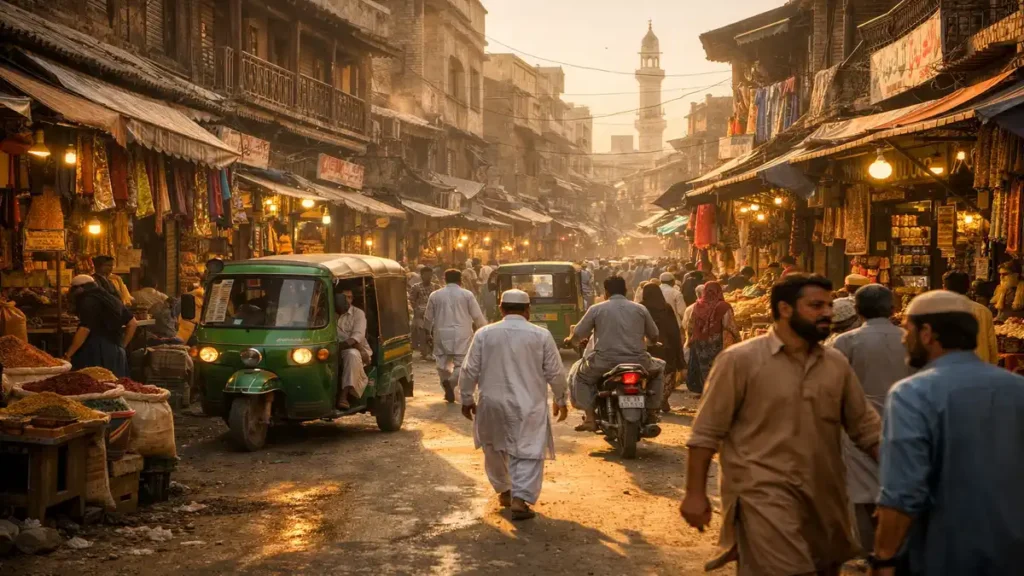
For over 150 years, Raja Bazar has been the beating commercial heart of Rawalpindi, the oldest and most famous market in the city. It continues to serve millions of buyers and sellers every year, from local residents looking for everyday items and traders from Azad Kashmir stocking up on wholesale goods, to tourists wanting to experience the city’s authentic culture. This place is not just a market; it is a living piece of history, telling the story of Rawalpindi from the days of Sikh rule through British colonial times and right into the present day.
The History of Raja Bazar Rawalpindi
The origins of Raja Bazar go back to the era before Pakistan’s independence. During the rule of the Sikh empire in Punjab, this area was already a point of trade and settlement. The Sikh and Hindu communities once lived and worked in these streets, and the buildings and havelis they left behind still stand in parts of the bazar today. Many of the older structures show antique woodwork, decorative grillwork on facades, and the classical architectural style that was common during that period.
When the British took control of Punjab in the 19th century, they developed this market further. The exact origin of its name is a matter of local lore. The most common theory is that it comes from the Rajput, or ‘Raja,’ caste of traders who were prominent here for generations. Another popular account credits a local landlord, Raja Sherbaz Khan, with donating the land for the market’s early development. The British era brought organized commerce to the area, and the foundations of what is now the largest wholesale market of Rawalpindi were laid during this time.
After the partition of 1947, the character of the bazar changed as Muslim traders took over and the Hindu and Sikh populations departed. The market continued to grow, absorbing neighboring areas and becoming larger and more diverse with each passing decade. Today, around half of the original shops have been joined together or converted into small plazas and joint markets, making the overall footprint of Raja Bazar significantly bigger than what it was a century ago.
The Traders’ Constitution
One of the most interesting facts about Raja Bazar is that its trading community has been governed by a formal set of rules for over 120 years. Late Haji Muhammad Ismael, the founding father of the Central Traders’ Association of Raja Bazar, crafted a written constitution1 to manage the discipline and conduct of businesses in the market. This speaks to the seriousness and organization of the trading community that has kept this bazar alive and functional for generations.
Location and How to Reach Raja Bazar
Raja Bazar is located near Fawara Chowk, which is widely known as the meeting point of six major roads. From this central roundabout, roads branch out toward Liaquat Road, Trunk Bazaar, Moti Bazaar, Bhabra Bazar, Namak Mandi, and Narankari Bazaar. The bazar connects Rawalpindi with key parts of the city including Saddar, Murree Road, Pirwadhai Bus Stand, and Liaquat Bagh, making it very easy to reach from any direction.
Because the streets inside Raja Bazar are narrow and extremely busy, driving a car or an SUV into the market is not advisable. The parking situation is very difficult and traffic congestion is a constant problem. Most regular visitors prefer to come by rickshaw, motorcycle, or cab and then explore on foot. The Rawalpindi Development Authority has a parking plaza at the center of the bazar area, which helps somewhat, but foot traffic is still the best way to move through this market.
What You Will Find at Raja Bazar
The sheer variety of goods available at Raja Bazar is what makes it so special. More than a thousand shops are spread across the market and its surrounding smaller bazars. The range of products covers almost every category imaginable, from fresh vegetables and spices to clothing, jewelry, electronics, household items, books, and raw materials.
Sarafa Bazar
This is the gold and jewelry section of Raja Bazar. Sarafa Bazar is known across Rawalpindi for its jewelers who deal in gold ornaments, silver items, and other precious goods. Buyers from across the region come here to purchase bridal sets, bangles, rings, and other pieces. Prices are relatively competitive compared to modern jewelry shops in malls.
Kapra Bazar
Kapra Bazar is the textile and garments section where you can find fabrics, ready-made clothes, and all kinds of dress materials. From casual daily wear to bridal outfits and formal suits, the range is impressive. Wholesale buyers stock up here before selling to customers in smaller towns and cities across Punjab and beyond.
Urdu Bazar
Urdu Bazar is dedicated to books and stationery. Students, teachers, and book lovers visit this part of Raja Bazar regularly. You can find textbooks, novels, Urdu literature, religious books, school supplies, and even second-hand books at very low prices. Roadside vendors also sell used books on the pavements, making it one of the more intellectually lively parts of the market.
Lakkar Bazar
Lakkar Bazar, which means the wood market, is where traders deal in timber, wooden articles, and raw materials for carpentry and furniture. This section serves both builders and craftsmen and has been a part of Raja Bazar’s commercial structure for many decades.
Masala Bazar and Sabzi Mandi
Masala Bazar is known for spices and dry goods, and the aroma when walking through this area is unmistakable. Alongside it, the Sabzi Mandi handles fresh vegetables and fruits. These sections of the market serve the daily needs of households from the old city area and the surrounding neighborhoods. Prices here tend to be lower than in modern supermarkets.
Moti Bazar
Moti Bazar has an interesting history of its own. It was named after a Hindu merchant called Moti Ram, who built a haveli here in 1883. The haveli, known as Kunya Ashram, was originally created as a shelter for Hindu widows. The widows were trained in cloth stitching and their work was displayed on the outer walls of the haveli for sale. After partition, the haveli was converted into a school and the surrounding area developed into a large market with over 1,500 shops across 12 smaller sections. Moti Bazar today is one of the busiest parts of the wider Raja Bazar complex.
Other Sections
Beyond these main sections, Raja Bazar also includes Nankari Bazar, Bhabra Bazar, a fish market, a sports goods market, Kohati Bazar, and several other smaller trading areas. Roadside vendors add another layer to the shopping experience, selling everyday items like hair accessories, bangles, bags, soap cases, buckets, ropes, and various household accessories at very low prices from pavement stalls.
The Weekly Juma Bazar
Every Friday, the pavements on both sides of the main streets of this Bazar fill up with a Juma Bazar, a weekly open-air market where vendors set up stalls selling an even wider variety of goods. This weekly event draws larger crowds than usual and is a tradition that has been part of Raja Bazar’s rhythm for many years. People come from different parts of the city specifically for the Friday market because of the range of products and the chance to find bargain deals.
Economic Importance of Raja Bazar Rawalpindi
Raja Bazar is not just a shopping area. It is an economic engine for Rawalpindi and the surrounding region. More than 2,500 shops provide direct employment to thousands of workers. On top of that, the broader market ecosystem includes banking branches, currency exchange services, hotels, restaurants, logistics businesses, and a range of support services that keep the market running.
Traders from Gilgit-Baltistan, Khyber Pakhtunkhwa, and Azad Kashmir regularly visit this place for their wholesale purchasing needs. According to the General Secretary of Raja Bazar’s Central Traders’ Association, Abrar Sheikh, the market connects the north of Pakistan with the south and serves as a key trading hub as it plays a key role in regional wholesale trade, particularly serving northern areas of Pakistan. This geographic and commercial position gives it an importance that goes well beyond the boundaries of Rawalpindi city.
The Architecture and Heritage Buildings
Walking through the older streets of Raja Bazar, you can still see buildings that date back to the Sikh era and the British colonial period. The facades of many old structures carry antique woodwork, carved balconies, and grillwork that speak to a craftsmanship no longer common today. Narrow lanes lined with multi-storey buildings create a dense, atmospheric setting that feels different from any modern shopping area.
Among the notable structures still standing is Lal Haveli, a historic mansion in the area that carries its own stories from before partition. There are also remnants of old forts, temples, mosques, and community centers that reflect the multi-religious character that this part of the city once had. Old godowns and merchant warehouses are mixed in with the shops, giving the area a layered quality where history and commerce occupy the same streets.
Unfortunately, many of these old buildings are in poor condition. Some have been demolished to make way for modern plazas, and what was once a rich streetscape of pre-partition architecture is slowly disappearing. Local historians and heritage advocates have raised concerns about the pace at which these structures are being lost.
Street Food in Raja Bazar
Raja Bazar is also well known for its street food. Dozens of small eateries and food stalls are scattered throughout the market, serving traditional Rawalpindi favorites at affordable prices. Nihari, fish fry, soup, lassi, khoya falooda, gol gappay, samosas, and chaat are among the most popular items. Seasonal foods also appear regularly, with vendors adjusting their menus to what is locally available and in demand at different times of the year. For visitors who want to taste authentic Rawalpindi street food, the lanes around this place offer a genuinely good experience.
Recent Development Plans
In February 2025, the Rawalpindi Municipal Corporation, the District Administration, and the Parks and Horticulture Authority announced a three-phase beautification plan for this site. In the first phase, rickshaws and Suzuki vans are being stopped from halting at Fawara Chowk to reduce congestion. The second phase involves stronger traffic management by the city’s traffic police.
The third and most ambitious phase involves moving all electricity, telephone, and cable lines underground, which would dramatically improve the look and safety of the market’s streets. If completed successfully, these improvements could make it a cleaner, more organized, and more visitor-friendly destination while preserving its historic character.
Practical Tips for Visiting Raja Bazar
Visiting Raja Bazar is best done on foot, so wearing comfortable shoes is a good idea. The market is extremely crowded on weekdays and even more so on Fridays because of the Juma Bazar. Early morning visits are quieter and more pleasant if you want to browse without too much crowd pressure. Bargaining is a standard practice throughout the market and vendors generally expect it. Asking for a reduction of 20 to 30 percent from the initially quoted price is common and usually successful.
Keep your belongings secure, as any very crowded market environment can attract pickpockets. It is better to carry a small bag and keep your phone in a front pocket. Visitors with young children may find the narrow streets and heavy crowds a bit overwhelming, so planning the visit accordingly is wise.