Saddar Bazar is the main commercial hub of Rawalpindi and one of the most well known marketplaces in the twin cities of Rawalpindi and Islamabad. Located between Mall Road and the main railway lines, this busy neighborhood has served as the commercial heart of Rawalpindi Cantonment for over 170 years. The word Saddar itself comes from Arabic and means center or headquarters, which perfectly describes the role this area has played since the British colonial era. Today, Saddar covers roughly 5 square kilometers and is home to around 200,000 people, making it one of the most densely populated commercial zones in northern Punjab.
Historical Background of Saddar Bazar
The story of Saddar Bazar begins with the British annexation of Punjab in 1849 after the Second Anglo Sikh War. Rawalpindi was already a strategic trade center during the Sikh era, but the British saw its potential for military purposes. They chose the city as their northern command headquarters because of its location and favorable climate. The 53rd Regiment of Queen Victoria was the first army to arrive and establish a base here. Within a couple of years, a permanent cantonment was set up under the orders of the 1st Marquess of Dalhousie, James Broun Ramsay, who served as the Governor General of India from 1848 to 1856.
As the cantonment grew, the British built a network of roads, railways, barracks, hospitals, churches, and schools to support their troops and officials. A post office, railway station, and telegraph office were constructed by 1857. However, the local economy really picked up pace when the British invited locals to open shops and build residences inside the cantonment area to serve the needs of army personnel. This is how Saddar Bazar came into being as the primary business district of Rawalpindi Cantonment.
Important Roads and Landmarks
Saddar Bazar is spread across several important roads, each with its own identity and commercial character.
Bank Road is perhaps the most famous road in Saddar. Its old name was Lawrence Road, and it runs parallel to Mall Road. This road has traditionally been known for banks, photocopier shops, and handicraft outlets. It connects Murree Road with Mahfooz Road, which leads to the city railway station. Bank Road has always been the main thoroughfare for transportation connecting different parts of the city and Islamabad.
Adamjee Road is named after Sheikh Adamjee Mamojee Hakimjee, a prominent businessman from Rawalpindi. This road starts from Sarwar Road at the Punj Sarki (Five Road) fuel station and crosses Kashmir Road before heading towards the northbound railway. It is known for automobile spare parts shops that stock parts for almost every car model running in Pakistan. The famous Chhota Bazar, one of the oldest markets in the area, is also located on this road.
Kashmir Road, formerly called Dalhousie Road, is another key artery. It connects Mall Road with Murree Road at Mareer Chowk. This road is famous for branded garment shops, automobile spare parts, meat and poultry markets, and ladies tailoring shops. It once housed the General Post Office and the American Centre Library, which was unfortunately destroyed during unrest in 1979.
The Rawalpindi Railway Station, built in the late 19th century, stands as one of the most iconic colonial era landmarks in Saddar. Opened in 1881 to connect Lahore and Peshawar through Rawalpindi, the station still functions as a major transportation hub.
Shopping Experience in Saddar
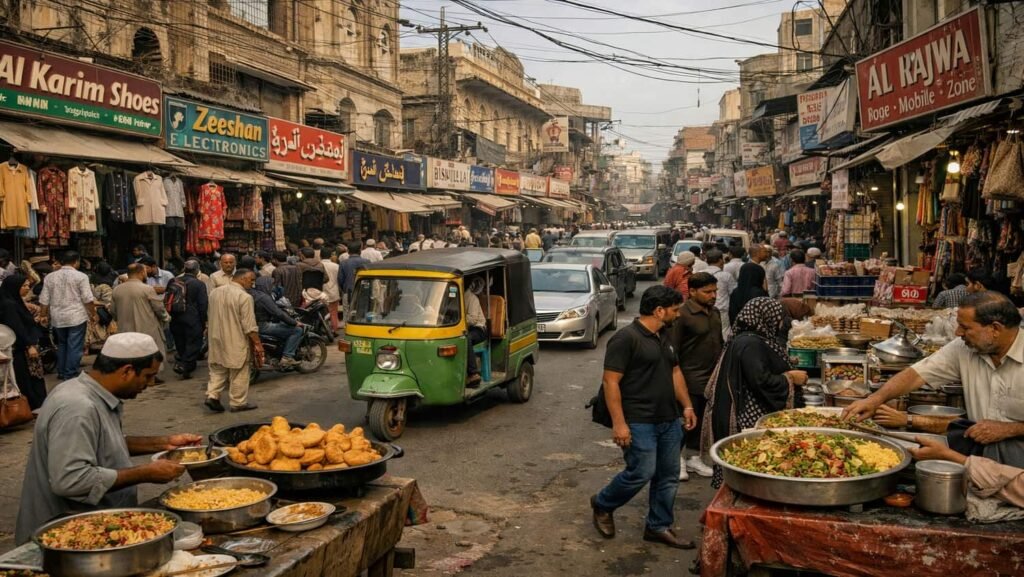
Saddar Bazar offers one of the most diverse shopping experiences in the Rawalpindi Islamabad region. Whether you are looking for clothing, electronics, mobile phones, shoes, household items, or groceries, you can find almost everything here under one commercial umbrella.
The bazaar has always attracted shoppers from across the twin cities because of its variety and competitive prices. Bargaining is a common practice, and experienced shoppers know they can get good deals if they negotiate well. The Landa Bazar section of Saddar is especially popular among budget shoppers looking for imported secondhand clothing and branded items at lower prices.
Food is another major attraction. The streets of Saddar are lined with restaurants, cafes, and street food stalls serving everything from traditional Pakistani dishes like biryani and kebabs to fast food. Saddar has long been considered one of the best places in Rawalpindi to enjoy mutton karahi and shinwari karahi.
The Recent Renovation and Pedestrian Street
Saddar Bazar has gone through a major transformation in recent years. The Rawalpindi Cantonment Board (RCB) undertook an ambitious renovation project that has changed the look and feel of the entire area. The project was completed in phases, with Phase I being formally inaugurated in February 2025.
The renovation cost approximately Rs 1.25 billion and was completed in about one year. The major upgrades include underground electrification on Bank Road, Adamjee Road, and Saddar Road, renovation of roads, standardized shop signboards, improved pedestrian pathways, modern street lighting, benches, executive washrooms, and food stalls.
The most notable change has been the conversion of Bank Road into a pedestrian only zone. Motorized vehicles have been completely removed from this stretch, which runs from the Metro Bus stop to the famous Capital Octroi near Gakhar Plaza. This is not the first time such an attempt was made. Back in 2015, the road was briefly converted into a pedestrian zone, but vehicular traffic was allowed back after just one year. This time, the project appears more permanent and well planned.
To address the parking concerns of shoppers and traders, the RCB has designated multiple parking areas. Potohar 1 parking can accommodate more than 400 vehicles, while Potohar 2 holds over 220 vehicles and is being further expanded. The Varan Bus Station has also been made available for parking with a capacity of over 300 vehicles. Electric shuttle vehicles have been introduced to transport people from parking areas to market outlets.
Reaction from Traders and Visitors
The renovation has received mixed reactions. Visitors have largely appreciated the new look. Many people have compared the revamped Bank Road to European pedestrian streets because of its clean environment, organized layout, and modern lighting. Families and friends now come to Saddar not just for shopping but also for a leisurely evening walk, which was not common before.
However, some traders have expressed concern that the pedestrian zone has hurt their business. The Cantonment Traders Association has pointed out that while the number of visitors has increased, many of them are window shoppers rather than buyers. Some shopkeepers feel that their regular customers have shifted to Commercial Market in Satellite Town or to Islamabad for convenience. The lack of nearby parking remains a concern for many despite the designated parking areas.
Despite these challenges, the general consensus is that the renovation has been a positive step for Saddar Bazar. The cleaner streets, better lighting, underground cabling, and organized infrastructure have improved the overall shopping and living environment in the area.
Population and Demographics of Saddar Bazar Rawalpindi
Saddar has a population of around 200,000 people. The majority of residents are Punjabis, with smaller communities of Urdu speaking Mohajirs, Kashmiris, and Pashtuns. The area has a dense cluster of both residential and commercial buildings, making it one of the busiest neighborhoods in Rawalpindi. The Cantonment Board, which is under the administrative control of the military, manages the civic affairs of Saddar.
Nearby Attractions
Saddar is surrounded by several important landmarks and recreational spots. Liaquat Bagh, formerly known as Company Bagh, is a historic public park near Saddar where Pakistan’s first Prime Minister Liaquat Ali Khan was assassinated in 1951. Ayub National Park, spread over 2,300 acres on the outskirts of the area, is a popular spot for families and outdoor activities. The Army Museum is located nearby and offers insights into Pakistan’s military history. The Rawalpindi Cricket Stadium and several colonial era buildings also add to the historical character of the neighborhood.
Also read this article about Raja Bazar Rawalpindi